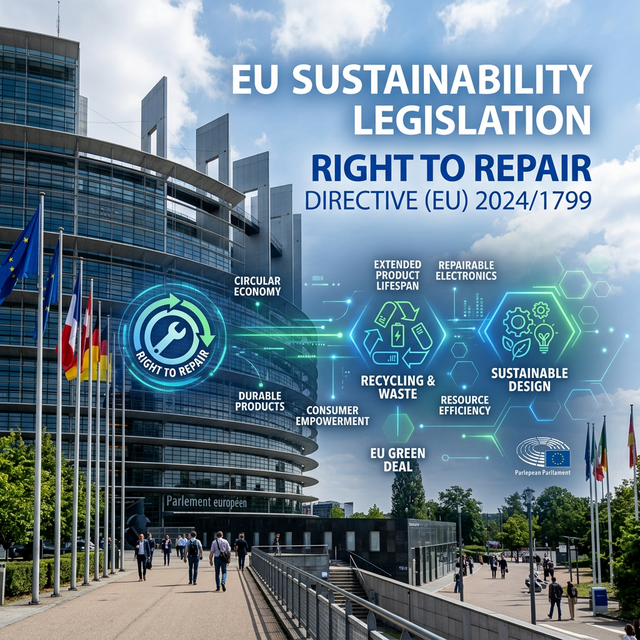
What Is the Right to Repair Directive?
The Right to Repair Directive (Directive EU 2024/1799) is landmark European legislation that establishes a legal framework for product repairability across all 27 EU member states. Adopted in 2024, this directive is designed to promote a culture of repair over replacement, reduce electronic waste, and empower consumers with tangible rights regarding the products they purchase.
For businesses — particularly manufacturers, importers, and retailers — the directive introduces a new set of obligations that must be understood and integrated into existing operations. Non-compliance carries significant legal and financial risks, making early preparation essential.
The directive applies to a wide range of electronic and electrical products, including smartphones, tablets, washing machines, dishwashers, and other household appliances. It builds on existing EU ecodesign regulations and extends them with specific consumer-facing requirements.
Key Obligations for Businesses
The directive places specific obligations on different actors in the product supply chain. Understanding these requirements is the first step toward compliance:
- Manufacturers must make spare parts, repair manuals and the tools needed for repair available under the ecodesign regulations for the individual product categories. The Right to Repair Directive builds on those requirements: where a manufacturer offers spare parts, it must provide them at a reasonable price that does not deter repair.
- Importers are responsible for verifying that the products they import comply with the repairability requirements. They must maintain records and cooperate with market surveillance authorities.
- Retailers must inform consumers about their right to repair at the point of sale and provide information about available repair services. They are required to display repairability scores where applicable.
- All obliged entities must publish indicative prices for typical repairs on a freely accessible website, and must not use contractual, hardware or software barriers to repair unless justified by legitimate and objective factors.
Timeline and Implementation
The directive was adopted in 2024, and EU member states have until 2026 to transpose it into national law. This means that the specific requirements and enforcement mechanisms may vary slightly between countries, but the core obligations remain consistent across the EU.
Businesses should begin preparing now, as the transposition period is already underway. Early adoption not only ensures compliance but can also provide competitive advantages in a market increasingly driven by sustainability concerns.
How ELOEE Simplifies Compliance
ELOEE provides digital infrastructure that helps businesses with Right to Repair Directive compliance. The platform offers:
- Repair request intake: A white-label widget for customers to submit repair requests directly from your website.
- ERIF issuance: The European Repair Information Form issued on the repairer's behalf and delivered to the customer.
- Repair network coordination: Assigning requests to a repair partner.
- Case records: Records of communication and forms, ready to export for inspections.