The Linear Economy Is Broken
For decades, the electronics industry has operated on a linear model: take raw materials, make products, use them briefly, and throw them away. The result? Europe alone generates millions of tonnes of electronic waste every year, making it one of the fastest-growing waste streams in the world.
This "take-make-dispose" model is not only environmentally destructive but economically wasteful. The European Commission estimates that the EU loses over €5.8 billion annually in valuable materials that could be recovered through proper repair and recycling programs.
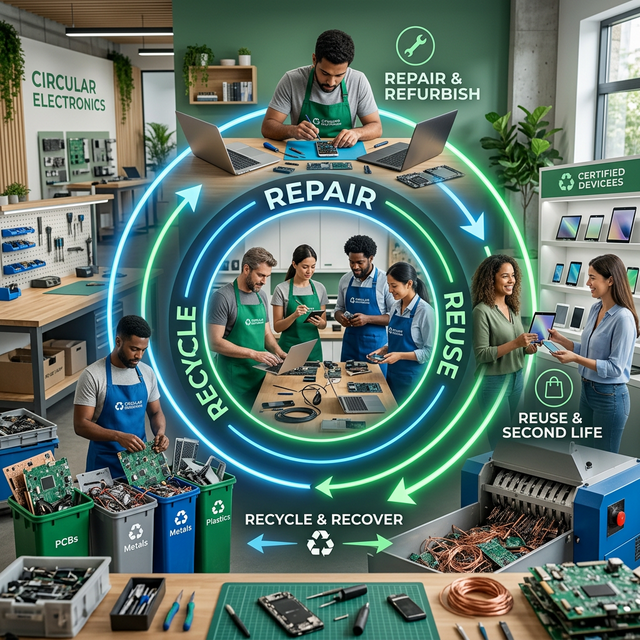
The circular economy offers a fundamentally different approach: design products to last, make them easy to repair, reuse components, and recycle materials at end of life. This model keeps resources in use for as long as possible, extracting maximum value before recovering and regenerating products and materials.
Repair: The Missing Link
While recycling has received significant attention and investment, repair has long been the neglected step in the circular economy. Repairing a product is usually less demanding on energy and materials than manufacturing a new one.
The Right to Repair Directive (EU) 2024/1799 addresses this gap directly. By requiring manufacturers to repair selected products after the warranty, to publish indicative prices for typical repairs and not to impede repair, it creates the conditions for a repair ecosystem to develop.
- Energy savings: Repairing a smartphone uses approximately 50x less CO₂ than manufacturing a new one.
- Material preservation: A single smartphone contains over 60 different elements, many of which are rare earth minerals with limited global supply.
- Job creation: The repair sector creates local, skilled jobs that cannot be outsourced. The EU estimates that a fully developed repair ecosystem could create 200,000+ new jobs across member states.
- Consumer savings: Repair is typically 30-70% cheaper than replacement, putting money back in consumers' pockets.
The EU Green Deal and Digital Product Passport
The Right to Repair Directive doesn't exist in isolation. It's part of a broader EU strategy — the European Green Deal — that aims to make Europe the first climate-neutral continent by 2050. Related initiatives include:
- Ecodesign for Sustainable Products Regulation (ESPR): Sets minimum requirements for product durability, repairability, and recyclability.
- Digital Product Passport (DPP): A digital record that tracks a product's sustainability credentials, materials, and repair history throughout its lifecycle.
- Waste Framework Directive revision: Strengthens targets for waste prevention, reuse, and recycling, with repair playing a central role.
- Consumer Empowerment Directive: Requires businesses to provide consumers with information about product durability and repairability at the point of sale.
Together, these initiatives create a comprehensive regulatory framework that makes repair not just an option, but an integral part of how products are designed, sold, and used across Europe.
ELOEE: Building the Repair Infrastructure
ELOEE provides digital infrastructure that connects consumers, obligated businesses and repair partners:
- For consumers: Easy access to repair services, instant price estimates, and connection with verified repair partners across all 27 EU member states.
- For businesses: Automated compliance with the Right to Repair Directive, white-label repair portals, and real-time analytics.
- For repair partners: Access to a growing market of repair-conscious consumers and businesses, with tools to manage services efficiently.
The circular economy isn't a future vision, it's happening now. And repair is where it starts.